
The Hidden Cost of AI

The Hidden Cost of AI
In recent years, there has been a strong push to add AI to almost every website and platform. AI is powerful and exciting, and companies want to use it to stay competitive. It gives the impression of being modern and ahead of the market.
However, this excitement often hides the real cost of implementing AI.
What It Takes to Add AI to a Product
When you integrate AI into a website or tool, there is a basic flow that needs to be built:
- Backend code to prepare instructions (prompts) and data in the correct format (text, JSON, CSV, etc.)
- Sending this data to an AI service (such as OpenAI or Gemini)
- Reading and processing the AI’s response
- Showing the result on the website
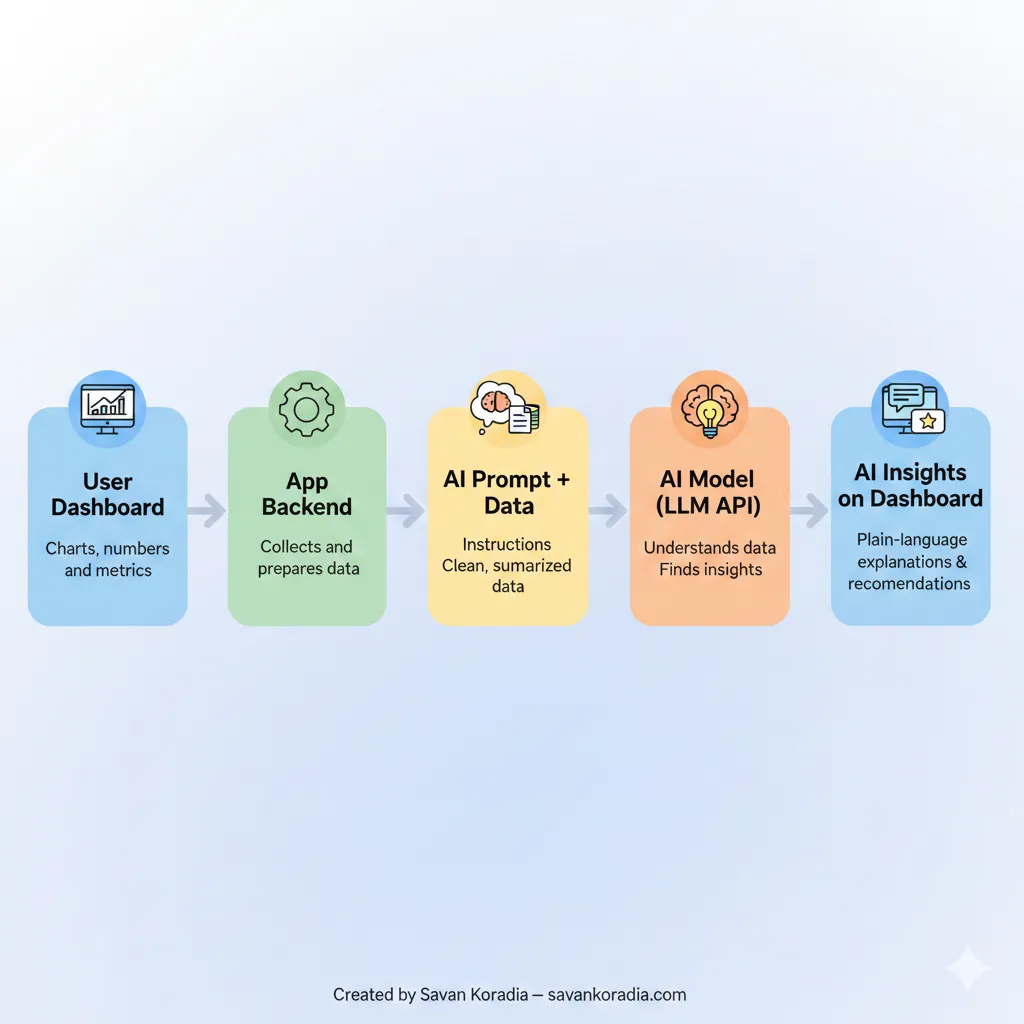
Now, let’s assume your platform uses Node.js as the backend.
The Goal
Add an AI feature to an existing Node.js platform that analyzes customer support tickets and generates a “Weekly Sentiment & Trend” dashboard.
1. The Implementation Approach (Direct AI Integration)
To achieve this, the team needs to build the following:
- Direct integration with AI providers like OpenAI or Gemini
- Use of provider-specific Node.js libraries
- Preparing user data along with clear instructions for the AI
- Caching results to avoid repeating the same AI request
- Creating logs and usage tracking to debug issues and monitor costs
2. Manpower & Cost Breakdown (India Benchmarks)
Let’s look at the hidden salary cost of building this feature.
Assume a 2-month development timeline.
| Role | Avg. Annual Salary (INR) | % of Time Spent | 2-Month Internal Cost |
|---|---|---|---|
| Sr. Node.js Developer | ₹28,00,000 | 50% | ₹2,33,000 |
| Frontend (React) Developer | ₹18,00,000 | 25% | ₹75,000 |
| Solution Architect | ₹40,00,000 | 15% | ₹1,00,000 |
| Total Engineering Cost | ₹4,08,000 |
Before paying even a single dollar to OpenAI or Gemini, the company has already spent over ₹4 lakhs on internal development.
3. Complexity and Vendor Lock-In
If your system is tightly connected to one AI provider, switching later is not easy.
To move from OpenAI to another provider like Gemini, the team would need to:
- Rewrite integration logic
- Learn and use a new library or API
- Re-test how responses are processed
If the AI provider has downtime, your feature goes down as well.
If another provider launches a cheaper or better model, switching becomes expensive and slow.
This creates long-term dependency and higher maintenance cost.
What If This Extra Work Was Removed?
Now imagine that these non-core tasks are removed from your team’s workload:
- Managing AI providers
- Switching between vendors
- Logging and usage tracking
- Cost monitoring
This allows the team to focus on the actual product feature, not the supporting infrastructure.
Using an AI Infrastructure Platform
Now consider using a platform that handles these complexities for you.
1. Simplified Implementation
The team only needs to:
- Call one API from the platform
- Select which AI model to use
- Send properly formatted data and instructions
- Store or cache the response
- Display the result on the website
What Is Removed
- No provider-specific libraries
- No custom logging or usage tracking
- No vendor-specific logic
2. Revised Manpower & Cost Breakdown
Timeline: 2 Weeks
| Role | Avg. Annual Salary (INR) | % of Time Spent | 2-Week Internal Cost |
|---|---|---|---|
| Sr. Node.js Developer | ₹28,00,000 | 50% | ₹54,000 |
| Frontend (React) Developer | ₹18,00,000 | 10% | ₹6,000 |
| Solution Architect | ₹40,00,000 | 5% | ₹10,000 |
| Total Engineering Cost | ₹70,000 |
The internal cost drops from ₹4 lakhs to ₹70,000.
So, the internal cost has dropped by around 75%.
3. Avoiding the Vendor Lock-In Trap
The biggest hidden cost of AI is not building it—it is migrating later.
When code is tightly bound to one AI provider, switching becomes painful.
An AI infrastructure platform works like a universal connector.
You write the code once and switch models from a dashboard:
- No code changes
- No redeployment
- No downtime
Feature Comparison
| Feature | Self-Built AI | AI Infrastructure Platform |
|---|---|---|
| Maintenance | Manual updates and fixes | Fully managed |
| Scalability | Complex custom setup | Built-in scaling |
| Visibility | Limited unless built manually | Real-time cost and performance data |
Conclusion: Focus on Value, Not Infrastructure
Building your own AI gateway is like building a power station just to switch on a light.
It distracts teams from what truly matters—delivering value to users.
The real goal should be to provide meaningful AI insights, not to maintain AI systems.
By choosing a unified AI platform, companies can save lakhs in development costs and stay flexible in a fast-changing AI world.